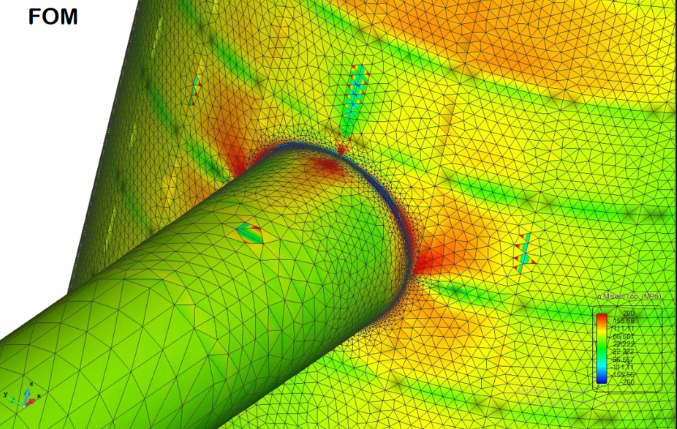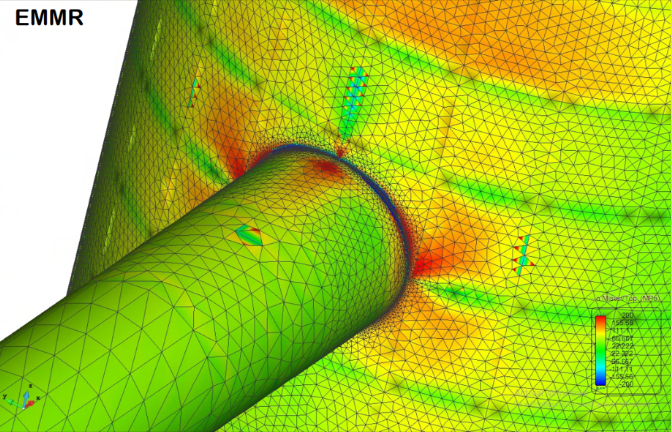
Following the recent Approval in Principle (AiP) granted by Lloyd’s Register for the Enriched Modal Matrix Reduction (EMMR) methodology implemented in SeaFEM, we would like to explain why this milestone matters for the future of structural assessment in naval architecture and offshore engineering.
Bridging efficiency and accuracy
The Enriched Modal Matrix Reduction (EMMR) approach combines the computational efficiency of reduced-order modelling with the accuracy of full-order finite element analysis, making fully coupled time-domain hydro-elastic simulations practical for engineering applications.
Until now, engineers have relied on approaches based on simplified global models combined with detailed local finite element models, introducing modelling approximations and uncertainties while preventing a fully coupled hydro-elastic analysis of the structural response. By drastically reducing simulation times while preserving engineering accuracy, EMMR overcomes these limitations, enabling advanced structural analysis to be integrated into industrial design, optimization, and certification workflows.
Turning innovation into industrial practice
This milestone paves the way for broader industrial adoption of reduced-order hydro-elastic modelling. We look forward to continuing our collaboration with industry partners to bring advanced simulation technologies into engineering practice.
The EMMR methodology, implemented in SeaFEM, was jointly developed by CIMNE and CompassIS in collaboration with ETSI Navales and independently reviewed by Lloyd’s Register as part of the AiP process.