Tdyn
Tdyn is an environment for computational fluid-dynamics (CFD), multi-physics simulation, and fluid-structure interaction calculations, based on the leading stabilized finite element method (FIC-FEM).
Tdyn includes different modules that allow to solve Heat Transfer problems in both fluid and solid domains (HEATRANS module), Fluid flow including turbulence phenomena (RANSOL module), Advection of Species in fluid and solid domains (ADVECT module), Structural mechanics (RAMSERIES module) and Free Surface (NAVAL and ODDLS modules) problems using the same stabilised scheme mentioned above. Tdyn also includes a module for geometry and data definition and post-processing of the analysis results (PREPOST module) based in the Custom GiD system.
By using Tdyn it is also possible to configure additional user defined partial differential equations (PDE) solvers in both fluid and solid materials (URSOLVER module) and to couple them with any of the other problems.
Finally, ALEMESH module can be used to simulate problems where mesh deformation (i.e. body movement) may occur.
The different modules of Tdyn are fully integrated and the complete environment is used as one single program.
Tdyn is highly flexible in defining physical properties of the model, boundary conditions, through user-defined functions that can make Tdyn a tool with large variety of applications. Moreover, Tdyn includes wizard-type utilities to make analyses definitions fast and easy to do.
Finally, Tdyn can be easily adapted to specific needs allowing a simple and automated analysis process.
Aplications
- Calculation of fluid loads and stress response on buildings and other structures
- Wind tunnel / model basin simulation
- Analysis of vibration modes, including fluid coupling effects
- Analysis of ventilation and refrigeration systems
- Thermo-mechanical analyses
- Calculation of industrial and biologic flows
- Analyses of transport and dispersion phenomena of polluting substances
- Determination and analyses of fluid separation phenomena
- Heat transfer analyses in fluids and solids
- Pressure loss calculation in tubes and valves
- Analysis of water impact phenomena
And lots more ...
|

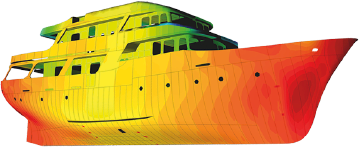
Analysis of a sailing hydrofoil (Navantia)
|
Characteristics
A detailed explanation of the capabilities of every Tdyn module is given next.
- RANSOL module features the latest technology for solving real fluid flows in 3D (transient or steady), including turbulence effects. The fluid models available allow to solve from fully compressible to incompressible fluid flow problems and porous media flows (Stokes problem in solid materials). RANSOL offers a choice of 14 different predefined turbulence models, including RANS, ILES (Implicit Large Eddy Simulation) and DES (Detached Eddy Simulation) types. It also allows the user to define new ones based on analytical expressions or by coupled systems of PDEs (URSOLVER module).
- HEATRANS module is able to solve complex forced, natural, and mixed convection heat transfer in fluids and conduction in solids. This module also includes conjugate heat transfer technology where calculation of thermal conduction through solid materials is coupled with the calculation of the temperature in the working fluids.
- ADVECT module allows to solve problems of advection/diffusion of species in fluids, including reactive effects. It is also able to solve species diffusion problems in solids (Fick’s law). ADVECT allows to define and track the evolution of a number of new species, being the physical properties and behaviour of the fluid flow defined in terms of the species concentration.
- URSOLVER module is able to solve user-defined PDE problems in fluids and solids. Furthermore, this module features a powerful Tcl interface enabling integration into design processes, faster completion of repetitive tasks and further extension of Tdyn capabilities.
- When fluid flow simulations involve changing geometry, ALEMESH module can be used. This module includes several mesh updating strategies: prescribed / free bodies movement with automatic mesh updating, explicit 3D mesh movement via user functions and combinations of these strategies.
- NAVAL module adds leading edge capabilities for the analysis of naval hydrodynamics problems. NAVAL module is able to solve free surface equations, based on the transpiration technique, largely improving the resolution of the free surface deformation, even for coarse meshes.
- If required, solid stress analysis may be performed by means of RAMSOLID module. In those cases, the structural analysis may be coupled with any other variable of the problem. This module includes a simple and accurate method for analysis of thermo-mechanical problems.
- ODDLS module features the leading overlapping domain decomposition level set technique, developed by Compass IS for free surface simulation. This methodology is based on the application of domain decomposition techniques and allows increasing the accuracy of the free surface capturing (level set equation) as well as precisely solving governing equations in the interface between two fluids, taking into account surface tension effects. The greater accuracy in the solution of the interface between the fluids allows the use of non-structured meshes with larger elements in the free surface.
- RAMSERIES module includes tools to perform calculations of solids, beams and shells using the Finite Element Method (FEM), as well as fluid-structure interaction analyses.
- Tdyn includes a fully integrated pre and post processing environment specifically designed for the creation and adaptation of analysis geometry, as well as the later visualization of results. The pre-processing part allows the generation of complex geometries defined by typical CAD entities, such as NURBS or COONS surfaces, through the variety of tools available. In the same way, it is able to import standard CAD files in IGS and DXF formats among others.
System Configuration
Tdyn is developed using C++ Tcl/Tk and OpenGL and is optimised for the best performance possible in UNIX workstations and PC computers under Windows or Linux, with seamless transfer of data between Windows and Linux/Unix.
Windows
- Windows NT/2000/ME, XP/XP64, Vista/Vista64
- Minimum requirements: 2.0 GB RAM, 100MB of hard disk space
- 3 button mouse recommended (SpaceBall supported)
- Support any graphics card with OpenGL acceleration
Linux / Unix
- Linux kernel version 2.0.30 or higher
- Minimum requirements: 2.0 GB RAM, 100MB hard disk space
Note: 1 GB RAM allows the analysis of 3D problems up to 2.0 Million Linear Tetrahedra (32 bits processors). Every additional GB increments this limit in about 2.5 Million Linear Tetrahedra
Tdyn